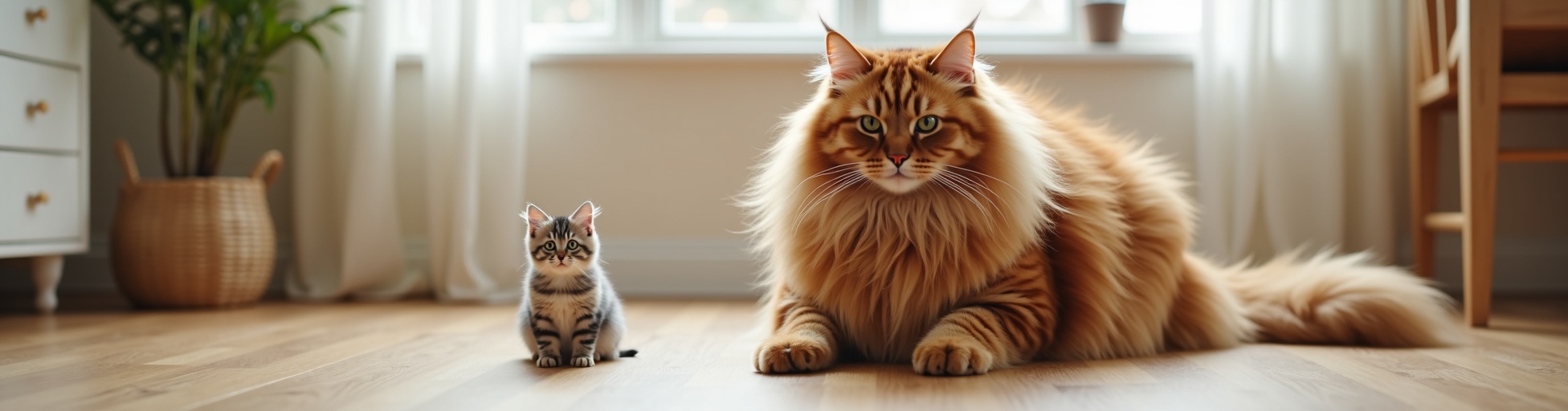
Giant Maine Coon cats are one of the most searched terms in the cat world right now — and for good reason. These cats are genuinely, legitimately enormous. But the internet has also created a mythology around Maine Coon size that sets buyers up for confusion and disappointment. Here is the honest, complete guide to what giant Maine Coons actually are, how big they really get, and what you need to know before you go looking for one.
01How Big Do Maine Coons Actually Get?
Maine Coons are the largest domestic cat breed recognized by major registries. But "largest" covers a wide range, and the viral photos you have seen online represent the extreme end of that range.
- Average male Maine Coon: 15–18 lbs, 10–16 inches tall at the shoulder, 19–32 inches body length (not including tail).
- Large males from heavy-boned lines: 20–25 lbs is achievable and not uncommon in well-bred cats from size-focused programs.
- The record holders: Stewie, the Guinness World Record holder for longest domestic cat, measured 48.5 inches from nose to tail tip. Barivel, the current record holder, is 47.2 inches.
- Female Maine Coons are significantly smaller: typically 8–12 lbs, occasionally reaching 14–15 lbs in large-framed lines.
- A healthy 25 lb Maine Coon is a genuinely large cat. A 30+ lb Maine Coon is exceptional and rare — and weight alone is not the right metric. Frame size, bone density, and length matter more than the number on the scale.
02What Makes a Maine Coon "Giant"?
The term "giant Maine Coon" is not an official breed designation — it is a descriptor used by breeders and buyers to indicate cats from bloodlines selectively bred for maximum size. Understanding what drives size helps you evaluate breeders' claims.
- Genetics is the primary driver. Size is heritable, and breeders who consistently produce large cats are selecting for size-positive genetics across multiple generations.
- European bloodlines are frequently associated with larger size — particularly Russian and German lines that have emphasized heavy bone structure and large frame for decades.
- Nutrition matters significantly during kittenhood. Maine Coons grow slowly — they do not reach full size until 3–5 years of age. Proper high-protein nutrition during that growth window affects final size.
- Sex matters enormously. If you want the biggest possible Maine Coon, you want a male. Females from the same litter will typically be 30–40% smaller.
- Neutering timing has some effect on size — cats neutered before sexual maturity tend to grow slightly larger because the growth plates close later.
03The Viral Photos: What You Are Actually Seeing
The Maine Coon photos that go viral — the ones where the cat looks the size of a medium dog — deserve some honest analysis.
- Forced perspective is real. Holding a cat close to the camera while the owner stands back makes the cat look dramatically larger than it is. This is a common photography technique.
- Some of those cats are genuinely enormous. Barivel, Ludo, and other documented record-holders are real and really that big.
- Many "giant Maine Coon" photos circulating on social media are of Norwegian Forest Cats, Siberian cats, or mixed breeds — not purebred Maine Coons.
- A legitimately large Maine Coon from a reputable breeder is still an impressive, head-turning animal. You do not need a 30 lb cat to have a cat that makes people stop and stare.
- Be skeptical of breeders who promise specific adult weights. Responsible breeders can give you a range based on the parents' size — they cannot guarantee a specific number.
04Living With a Giant Maine Coon: The Practical Reality
Before you commit to the largest Maine Coon you can find, make sure you understand what daily life with a 20+ lb cat actually involves.
- Litter boxes: Standard litter boxes are too small. You need extra-large or jumbo boxes — ideally at least 24x18 inches. Many giant Maine Coon owners use large storage totes.
- Food costs: A 20+ lb cat eats significantly more than a 10 lb cat. Budget accordingly for high-quality protein-rich food.
- Vet costs: Larger cats require larger doses of medications and anesthesia. Some procedures cost more simply because of body weight.
- Furniture: Maine Coons love to be up high. Standard cat trees may not support a 20+ lb cat safely. Invest in heavy-duty, wall-mounted options.
- Lap cat reality: A 22 lb cat on your lap is a commitment. They are warm, they are heavy, and they will cut off circulation to your legs. Most Maine Coon owners consider this a feature, not a bug.
- Travel: Standard soft-sided carriers are not appropriate for large Maine Coons. You need a hard-sided carrier rated for their weight.
05Health Considerations for Large Maine Coons
Size and health are related in Maine Coons, and larger cats carry some specific health considerations worth understanding before you buy.
- HCM (hypertrophic cardiomyopathy) is the primary genetic health concern in the breed and is not directly related to size — but it is more common in males, who are also the larger sex.
- Joint health: Very large Maine Coons can be prone to hip dysplasia and joint stress. Keeping them at a healthy weight (not overweight) is important.
- Spinal muscular atrophy (SMA): A genetic condition that affects muscle development. Ask your breeder whether SMA screening is part of their program.
- Obesity risk: Maine Coons love food and can become overweight easily. A 25 lb Maine Coon should be 25 lbs of muscle and bone — not fat. Learn to body-condition score your cat.
- Cardiac screening: All Maine Coons, especially males from large-framed lines, should be cardiac-screened annually by a board-certified cardiologist.
06How to Find a Reputable Giant Maine Coon Breeder
The demand for giant Maine Coons has attracted a lot of bad actors. Here is how to find a breeder who is actually producing what they claim.
- Ask to see photos of the parents — both of them, not just the more impressive one. Size is heritable from both sides.
- Ask for the parents' weights and measurements, not just estimates. Reputable breeders weigh their cats.
- Ask about the specific bloodlines and why those lines are known for size. A knowledgeable breeder can explain this in detail.
- Ask the breeder directly about their health screening program — HCM, SMA, and PKD should all be part of any responsible Maine Coon breeding program.
- Be skeptical of breeders who guarantee specific adult weights. Genetics is not that precise.
- Expect to wait. The best breeders have waitlists. If a breeder always has giant Maine Coon kittens immediately available, that is a red flag.
07Empire Maine Coons and Size
Our program produces Maine Coons that are large, well-structured, and healthy — not cats bred purely for maximum weight at the expense of health or temperament. Our males consistently reach 18–24 lbs with proper bone structure and muscle mass. We incorporate European bloodlines selected for frame size and type, and every breeding cat is health-tested. If size is important to you, we are happy to discuss which kittens in a given litter are tracking large based on their growth curves.
Further Reading
Interested in bringing home an Empire Maine Coon?
